Monday, September 12, 2022

Home Sweet Home

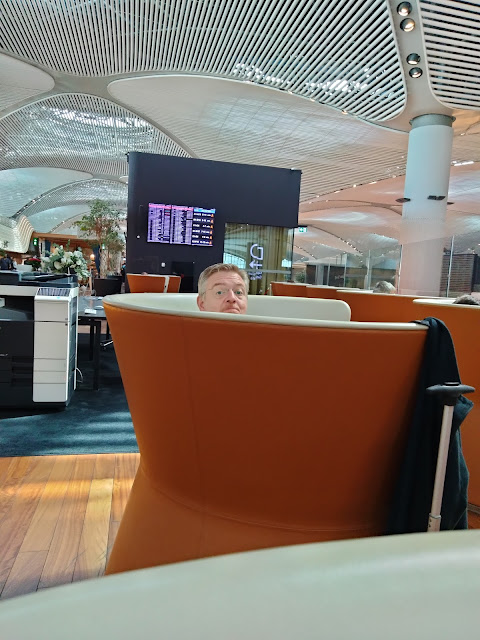
Turkish Airlines has two identical lounges in the new airport.  The one we visited on our first transit ended up being further from our gate, so we took a chance on the other one this time, but it too was further than the other would have been.  They don't announce gates for flights until 90 minutes before departure, so you have to take some chances.  This lounge had plenty of room and we each got an individual pod, in which we spent the multi-hour layover, which both of us thought passed rather quickly. 

Making the Most of Our Layover

We had yet another security screening at the gate for our flight to Washington, but that has become standard practice for flights to the United States.  To run the board, this flight too was completely full, and it was larger plane than the one we took from Dulles originally.  We had a slight delay, and ended up landing about 20 minutes late into Dulles.  Both of us got about five hours of sleep on the plane, which was nice.  

Waiting To Depart Istanbul for Washington


Departure Out of Istanbul

Immigration at Dulles was superfast with Global Entry, and we ended up waiting for the bags.  Unlike in Bucharest, our bags were among the very first to come off, so we were in the Uber and on the way home in under 10 minutes.  It was almost 8:30pm when we got the bags into the house.  We hadn't been thrilled with the late arrival, but it ended up working out, as we both went to bed shortly after calling Anna to let her know we'd made it home and that the trip had far exceeded all of our expectations.

Sunday, September 11, 2022

Is It Time Already?

The majority of our tour group had very early-morning flights out of Bucharest, with most people having airport transfers around 3:00 and 4:00am.  We were again flying through Istanbul on our return leg, and our flight didn't leave until the more civilized hour of 8:40am.  Our driver was to pick us up at 6:00am and, as it was, we were both dressed and ready early.  We went to the lobby around 5:45 and were advised our driver was already waiting, so we piled in and headed out into the still dark city.  When we got into the car, the driver had been listening to American rap music very loudly.  As though startled to realize we were in the car, he quickly turned the volume down.  He fiddled with his Spotify account on his phone and next thing we knew we had an Elvis playlist for the 20+ minute ride to the airport.  We both presumed he figured Elvis was as American as music can come.  We chuckled, though, as the shuffle feature ended up playing Blue Christmas twice, and I don't like the song even during the holidays, let alone in September.

The airport was quite the scene, and very crowded.  It was typically European in that you had to go to a central board, look up your flight, and then they showed the number of your check-in area.  I have always hated that, but for some reason it persists.  Our first flight of the day, to Istanbul, was actually operated by Tarom, the Romanian airline, so I shouldn't have been surprised that the line was long.  Still, as we walked to the far end of the terminal, I saw a long line doubled back on itself.  As I tried to figure out what they were waiting for, I realized they were all trying to check-in, and the line continued up and around the corner, to a check-in counter I still could not see.  Luckily I was still trying to locate the counter and puzzling over the line, so I pushed our way through the line to the far side.  Realizing that very line led to our counter, I worried about time.  We were flying business class, so I figured there had to be a separate line somewhere.  I walked up and around the security partitions and finally (and rightly) guessed that there was a separate line, though you could not see it, as it was hidden by all the other people.  Katherine and I got in that line, which was mercifully short.  Once at the counter, things were extremely smooth.  Security was surprisingly quick, especially considering the level of activity within the airport.  Immigration control was super quick, too.  We spilled into the main departures terminal, however, and it was frenetic with activity.  So many people and so many morning flights.  The departures terminal was obviously part of the original airport, whereas the arrivals hall had been added some time later.  We made our way upstairs to the Tarom lounge, which was surprisingly small.  We could not find a seat anywhere, and eventually asked if we could sit a table with another couple.  I should add, too, that like everyone else in Romania, there were no masks to be seen, anywhere. Katherine and I had been wearing ours since we got into the car at the hotel, but we were literally the only people doing so.  

While better than sitting at the gate, the lounge was pretty much a caricature of a third-world lounge.  There were women dressed in white smocks manning a long case, behind which they were small sandwiches in plastic wrapping.  There were large bowls of chips, nuts, cookies, etc., but you had to ask one of the ladies to scoop you some of whatever you wanted into a plastic cup.  Drinks were poured by yourself, into plastic cups from large communal two-liter bottles.  Certainly not the Ritz, and we elected to stick to coffee.  Our tablemates soon left, so at least we had a table to ourselves for the hour-or-so wait before our flight was called.  

Our Flight to Istanbul (in retro Tarom livery from the 1960's)

Our gate was literally at the base of the escalator outside the lounge, and we ended up at the very back of the boarding line.  Again, the flight was completely full.  When we flew this same route in the opposite direction on our arrival, we traveled with Turkish Airlines, and they served a warm three-course meal during the hour-long flight.  We got a bottle of water on this Tarom flight.  Again, not the Ritz.  

Departing Bucharest

As with our first flight through the new Istanbul airport, we taxied for what seemed like hours.  I had expected us to be able to go directly to the Turkish lounge upon arrival, as we had done during our first transit, but instead we ended up walking a very long way, following signs for Arrivals/Transit.  As we walked, we lost those people going to arrivals, and then lost people transiting to domestic flights inside Turkey.  We finally reached the International Transit area, and I was dismayed to see that we had to go through a full security screening.  The line was extremely long.  We had plenty of time, so I had no worries about that, but the thought of standing for so long was not appealing.  I also had flashbacks to the time we arrived in Istanbul with Anna, during our return from Israel and Jordan, and vividly recalled the very strong body odor among people in that line with us.  We reluctantly joined the queue, but then I thought to ask a man helping direct people to either end of the long line if there was a dedicated screening area for business class.  He very politely told us we were in the wrong line, and that we had to walk further down, to another area.  He helped us essentially swim upstream and exit the closed off area.  A couple minutes further down we saw a dedicated business class line which only had about 10 people in it.  Relieved, we scanned our boarding and got in the queue.  We soon realized there was one family of five ahead of us, who were transiting from a flight from Mali, headed on to Dubai.  Ahead of them was an Arab family of six or so, who were in various stages of undress waiting to load their bags and go through the metal detectors.  At first we watched in amusement as they were repeatedly sent back one-by-one, and made to carry their bags back through, to again go through the x-ray machine.  After a few minutes, though, we were not laughing.  These people were obviously very rich, but obviously clueless, entitled, or both. How they had gotten through screening at whatever airport from which they left, I have no idea.  They were pulling all kinds of things from their bags -- drinks, cosmetics, other liquids, laptops, etc.  Every time something was pulled, they would argue that they needed it.  I lost track of how many bottles of perfume the guard pulled and then poured into a huge container close to us in line.  You can imagine the cacophony of odors.  It was as if they had never traveled, but I'm sure that is not the case, as they were wearing very expensive clothes, their bags were all designer, and they were covered in jewelry.  As we watched in somewhat horror this transpire, a couple from Africa joined the line behind us.  They were trying to make a flight that left in less than 15 minutes.  We told them to go ahead of us, and the other group of Africans did the same.  The couple was then stuck directly behind the Arabs, who FINALLY cleared after at least 20 minutes of back and forth.  The African couple were literally pleading with the security agents to let them through. Once it was their turn, however, THEY TOO had to keep sending their bags back.  They each had water on them.  They each had liquids in their bags.  They each had metal they didn't remove before going through the machine.  They were desperate, but I lost all sympathy when I realized they had done nothing to help themselves.   They cleared, but we both doubt they made their flight.

Next up were the Africans from Mali.  After witnessing all that we too had seen, you would think they would breeze through.  WRONG.  They endured the same process.  Bags sent back repeatedly.  All kinds of items pulled from their bags and confiscated.  They all whined when their toothpaste was taken, claiming they could not get any more, etc. etc.  They even had perfume taken, and they had to have clearly seen what happened with the Arabs.  Katherine and I kept commenting to ourselves that all of these people had obviously flown in from somewhere else, and were simply transiting here, which meant that security at at least three airports was abysmal, and had let all of these items through.  It did not give me a warm-and-fuzzy feeling, but I did feel less annoyed by the fact that Turkey was making us go through screening again.  I'm happy to report that, as good travelers, Katherine and I know the drill well enough, we both got through screening on the first try and none of our bags were sent back.  The guards thanked us, and I thanked the supervisor, commending the patience of he and his team.

Wrapping Up and Farewells

Despite the earlier rain, when we reached Bucharest again, the skies were perfectly clear.  We were well clear of the mountains and driving through farm land, but you could see massive rows of smokestacks in the distance, in the direction we were traveling.  We learned these were parts of Romania's remaining oil refineries.  At the beginning of World War II, Romania was the largest producer and refiner of oil in the world, and I wrote how the Nazis grew dependent on that.  The oil refineries were concentrated around the city of Pioesti, north of Bucharest, and in 1943 the United States launched Operational Tidal Wave.  The plan comprised the sending of over 175 B-24 bombers from their base in Tripoli, Libya, and having them fly in complete radio silence at extremely low level, and then bomb the oil fields.  They would then attempt to make the return trip, or ditch their planes in neutral Turkey.  All kinds of things went wrong, and while some of the bombers did make it through, the damage was quickly repaired and, in fact, output at the refineries actually increased shortly afterwards.  Neither Katherine nor I had ever heard of this, so I read quite a bit more.  Evidently the raid, deemed "Bloody Sunday," is today taught as an example of a mission gone wrong, and it is often cited as one of the biggest failures of the war.  At least 53 bombers were lost and upwards of 700 U.S. servicemen.  I enjoyed hearing this new chapter of history for me, as we drew closer to Bucharest, for we were soon driving through the exurbs, with their IKEAs and malls.     

I'd been openly voicing the hope that I could see Bucharest in the sunlight, as I had such dour recollections of it from our initial couple of days.  Well, fate obliged and indeed the city was attractive in the sunlight, and certainly had a much more cosmopolitan feel to it.  As a Sunday, too, there were lots of people filling the parks, and large areas of the downtown -- which weren't already closed to cars -- had been cordoned off for various outdoor activities.  We got some very nice views of the historic buildings that survived, but many of which still require a lot of TLC.  It almost seemed like a different city than the one we'd left exactly a week earlier.

Across From Our Hotel

The Press Building (a gift from Moscow in the 1950s') / Monument in Front is to the 1989 Revolution

Romania's Arc de Triomphe (1/3 scale of the one in Paris)

Upon arriving back at our original hotel, our guide assured us we would have a "disco-free" room, and we heard the same from the front desk clerk, as we were handed our keycards.  As before, the room was very nice, but it would be several hours before we knew if we were indeed in a "bass-free room."  I'll spare you any suspense and let you know that our room was exceedingly quiet all night.

Katherine was tired and elected to pack her things and rest before our farewell dinner celebration, whereas I elected to do some exploring on foot.  The outdoor cafes and bars were packed with people, including many groups of English tourists, which made me think back to what Kevin had said about weekend jaunts.  It was an exceedingly pleasant afternoon and I thoroughly enjoyed my jaunt.

Our Hotel in Bucharest


Church Physically Moved by Ceausescu, so He Wouldn't Have To See It

National Bank Buiding

I, too, packed upon my return, and we met our group in the lobby before we made the short walk to our farewell dinner site.  The Romanian ladies had already told us they were impressed with the place chosen for the meal, as it is evidently quite famous.  Hanul Manuc, or Manuc's Inn, and is the oldest operating restaurant in Bucharest, dating back to 1808.  It was opened by a wealthy Ottoman trader as a Khan, or waystation for traders and merchants. It became famous early in its existence, as it is where the peace treaty ending the Russo-Turkish war was signed in 1812.

We had a private room in the main building, which allowed us to share memories and break into groups to say farewells.  People did not linger too late into the evening, though, as so many people had very early wake-up calls, to make their flights back to the States.

Site of our Farewell Dinner

Before the Festivities Began


The Crowning Jewel...and Jewels

We were a little sad to be leaving Brasov, as there was much more to see and we simply didn't have enough time.  For reasons that are still not entirely clear, we had a new bus driver this morning.  We've always had the same driver for all of our tours, but the day before we'd been told that our regular driver had to depart, and a new one was being sent up from Bucharest.  Kevin, the former Gate1 employee, believed it had to do with an arcane EU law regarding driving times and assignments for bus drivers.  I won't pretend to recreate the rule as he explained it to me, as it made next to no sense, but given some of the labor laws in France, for example, nothing would surprise me.

Weather was again spectacular and the opposite of what had been forecast. Our destination this morning was the Peles royal castle in Sinaia.  As a picture of the castle graces the cover of our travel guide, I had been anticipating this stop.  Over the course of the tour, we'd already heard quite a bit about the Romanian royal family, but today would involve an even deeper dive, including the drama carrying through to this very day.  In 1859, the principalities of Moldova and Wallacia (southern and northeastern Romania) were united one one country, with a titular prince at its head.  That did not not last long and was not very stable, so the ruling elite decided they needed to install a "stable" royal family.  And where do you go for stability?  Why, Germany of course.  Carol, the son of a prince within the Hohenzollern-Sigmaringen family, accepted the proposal to become King of Romania.  This is the same family that produced "crazy" King Ludwig of Bavaria.  He became a prince in 1866, and while foreign born and not very popular, he raised in stature, particularly after leading Romanian troops in their successful campaign against the Ottoman Turks in 1877.  It was that defeat and Romania's ultimate independence from the Ottoman Empire that led to his proclamation as king in 1881, and Romania officially became a monarchy.  Carol and his wife only had one child, a daughter, who died in infancy, so there was no heir apparent when the king passed away in 1914.  Carol's brother had three sons, but both the brother and eldest son renounced the crown, so it fell to second-born Ferdinand, who was married to Marie, a granddaughter of Queen Victoria.

Before he died, as WWI was looming, King Carol voiced his support for Germany, should war breakout.  Hostilities began after Ferdinand ascended to the throne, and he attempted to remain neutral for a time.  That became impossible, and at the strong urging of Marie, Romania ended up declaring war on Germany in 1916 (Ferdinand's home country).  As they ended up on the winning side, the Treaty of Versailles laid the groundwork to restore Transylvania to Romania.  Ferdinand and Marie were then official coronated as King and Queen of Greater Romania in 1922 -- in the church I wrote about when we visited Alba Iulia.  

I'll take a pause here and write about Peles Castle, which we were about to visit.  From Brasov, we again (and for the final time) started to climb up and through the Carpathians.  The terrain here was markedly alpine in nature, and it looked like we were in Bavaria or Austria.  We passed through multiple toney looking ski resorts, many with casinos and lavish-looking hotels and spas.  

After Carol I became king, he visited this area and -- as it reminded him of home -- he elected to build a summer residence and hunting lodge here.  This grew into Peles Castle.  Work on the castle ran for over thirty years, but the king and queen occupied large parts of it before completion, and spent summers here.  The exterior does have a very German look to it, ala Neuschwanstein.  There were quite a few other visitors in the little town, but it was nowhere near the mayhem of Bran Castle.  Our regular guide actually led our tour through the castle, and her level of knowledge was really impressive.  The interior of the place far exceeded our expectations.  Every room was a work of art, and it managed to not be gaudy or TOO over the top.  Reportedly Emperor Franz Josef and Sofie visited Peles, and declared it the most magnificent castle in all of Europe.  I think both of us would have liked more time to explore the rooms, but there was simply so much to see.  We were fascinated to learn that the interior paintings were done by Gustav Klimt and his brother Franz.  Those paintings include numerous originals, but the Klimt's also created several reproductions of various masterpieces.  If given the opportunity, I would love return and spend an entire day just exploring all the various rooms and treasures.  Our guide lamented near the end that we had to proceed through, as other groups were coming in behind us.  She said that before Covid, they only let groups go through, and it was all timed.  If you were not part of a tour, you waited until a group reached sufficient size, and then you were let in.  Since Covid, and as they really need money for the upkeep, they started to allow individuals in, and that has resulted in more foot traffic. 

When the communists came to power, the palace and all its treasures became property of the state. It was set aside for use by "Romanian cultural personalities."  Under Ceausescu, though, it was closed entirely from 1975, and remained so until 1990.  I asked how they managed to protect all of the original treasures, which could have easily been destroyed or sold off for hard currency.  Evidently Ceausescu didn't like the place, and knowing of his extreme paranoia, he was told that there was a rare form of wood rot in the rafters, which could make him sick.  That ploy seemed to work, and thank goodness everything survived.  The castle, by the way, was returned to the royal family in 1997, and the current heir still uses it on special occasions, but she decreed that it remain open to the public as a museum.  
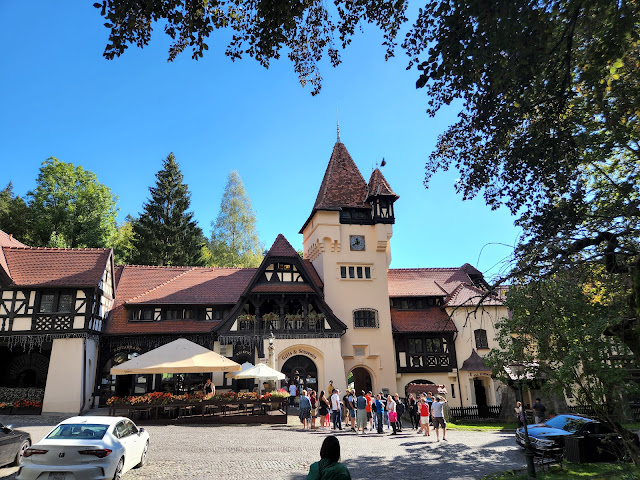
Exterior Housing (former for servants) at Peles Castle

Peles Castle


Primary Reception Hall


Full set of Armor Within the Armory

Evidently King Carol I Was a Collector

Painting of Queen Elizabeth (Carol I's wife) by Klimt (unique, as it showed the Queen as maternal)

King's Study

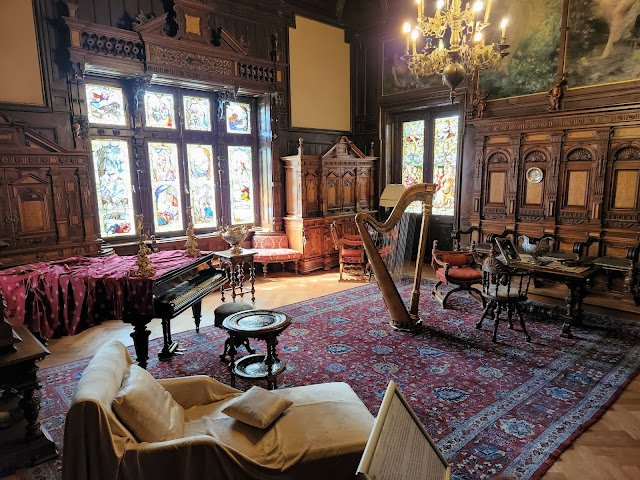
The Music Room

More Paintings by Gustav Klimt


The Moorish Reception Hall

Before heading back to the bus, we enjoyed a long sit in the sun, along with some cake and coffee.  Ironically, while here, we "collided" with two other Gate1 tours.  I may have mentioned earlier that while Gate1 has three tours that include Romania, we were on the only one that remained solely in the single country.  Our visit coincided with another tour -- Serbia, Romania, and Bulgaria -- that was just beginning their journey, as well as one of their so-called Discovery Tours, called Majestic Balkans.  That tour went as far as Albania, and Discovery Tours are designated as "small groups."  We laughed, though, when we learned that they had 17 in their group, whereas our "Classic" tour only had 16.  

As we drove out of Sinaia, we passed the train station where the Orient Express still stops to this day.  A short while, later, too, the skies opened up and it poured rain for over an hour.  Our next stop was Bucharest and, as we had seen Peles in brilliant sunshine, none of us were too disappointed. 

During the drive south, we heard more about the royal family and sad legacy post King Ferdinand and Queen Marie.  The king's crown prince was his eldest son, Carol II.  The heir, however, was a notorious scoundrel and womanizer.  Reportedly he'd be diagnosed as a sex addict in today's parlance.  He initially secretly married a dancing girl, but that marriage ended up being annulled, once the family became aware.  He was then forced to marry a princess from Greece, who gave birth to a son -- Michael -- seven months after their marriage.  Carol II had no interest in his new wife or child, and he renewed a relationship with a woman with whom he had an affair in his 20's.  He ended up renouncing the throne in 1925 entirely, abandoning his family, and moving Paris to live with his mistress.  Parliament was forced to declare his son, Michael, as the new crown prince.  King Ferdinand died in 1927, and young Michael became king at the age of six.

A regency was established to rule on behalf of Michael, but that did not last, and powerful politicians enticed Carol II to return from exile and become king in 1930.  He quickly turned into an autocrat and eventually ended up dissolving all the political parties and having the constitution amended to give him even more power.  As part of the Nazi-USSR non-aggression pact, however, Romania lost territory to the Soviet Union (the part of Moldova I mentioned earlier, and some other ancillary territory on the Black Sea).  This forced Parliament's hand, and they forced Carol II to abdicate in 1940.  That put Michael back in line for the throne, but he was only 19, and the senior general in the country -- Ion Antonescu -- convinced him that he had not yet reached majority in terms of "age and mind."  The new king essentially deferred all power to Antonescu, who declared war on the Soviet Union a year later, in hopes of retrieving the territories lost earlier.  That move aligned Romania with the Axis powers, and was a fateful decision.  The country quickly became the number one source of oil for the Nazi regime.

King Michael lamented the alliance with Germany and, sensing imminent defeat, he staged a coup in late 1944, had Antonescu arrested, and announced Romania's switch to the Allied side.  That decision ended up being key to Romania's survival as a country.  Though Romania ended up on the winning side, communists had been building in power and Stalin forced Michael to accept a prime minister of his choosing, and Michael became a figurehead.  He traveled to England in 1947, when and where he met his wife, and he was offered asylum by King George VI.  Michael declined, returned to Bucharest, and was quickly ambushed and forced to abdicate at gunpoint, appointing Gheorghe Dej, who was the first of Romania's two communist leaders.  Ceausescu was the second and last.  Historians credit Michael's decision to push Romania toward the Allies with saving the country, even if it was not his intent.  As soon as they switched sides, Germany lost their primary source of oil, which hastened the end of the war.  If the war had ended with Romania on the losing side with Germany, the modern consensus is that Romania would have been absorbed into the Soviet Union, rather than permitted to remain as a separate country, albeit in the Soviet orbit and serving as a buffer state.

Sorry to ramble on, but to close out the drama of the royal family.  Michael tried to return to Romania to visit his parents' graves in 1990, after the government fell, but was stopped.  It was not until 1997 that his Romanian citizenship was restored and he was allowed to return to visit.  He ended up dying in Switzerland at the age of 96 in 2017.  Michael never had a son, and the original agreement with the Hohenzollern-Sigmaringen family had been that only men could inherit the throne. If there was no male heir, the title would revert to the family in Germany.  In this case, it would have gone to a grandson, also named Michael, in whom Michael had little faith for still unclear reasons.  Before he died, he issued a decree declaring his daughter Margareta as his heir.  The entire squabble is technically moot and useless, as the royal family is prohibited from resuming control or claiming any authority under the new Romanian Constitution.  That said, the internal family squabble is still fodder for tabloids.  Michael (the snubbed grandson) is very popular, speaks Romanian very well, and spends time in the country, whereas Margareta is said to speak little to no Romanian and seems disinterested in even trying.  Evidently, too, the younger Michael even changed his name officially to be "Prince Michael of Romania," so the whole thing is rather silly.   

Saturday, September 10, 2022

Brosov My Brasov

On the drive back to Brasov, Iuliana went through multiple options for us to spend the remainder of the day, which was on our own.  There were plenty of things to do, including a big fair in the old city, as it was Saturday.  The Romanian ladies were going to take a bus up to a ski resort several miles outside the city, which is known for tremendous views and several restaurants famous for serving all sorts of game, including bear, which are quite prevalent in the area.  As the whether was nice, she had our driver take us up part of the way, to an overlook above the city.  While taking pictures, she surprised us with homemade Cherry brandy she had made, along with locals meats and cheeses.  It was a really nice way to end our time with the group for the day, and recover from the relative chaos of Bran Castle.

View Down to Brasov

Bear Warning Signs Were Everywhere

The day had proven to be quite warm, and while we probably should have changed before leaving the hotel, we didn't.  We headed right out, wanting to visit the fair, walk around the old city, visit their famous "Black Church," and we were going to take a funicular from the city center up the central hill overlooking the town, on which large letters spelling "BRASOV" had been erected, similar to the HOLLYWOOD sign.  It was probably in the 80's this day, and we had been spoiled by much cooler weather, so we took many breaks and ducked into shops trying to cool off.  

We visited the so-called Black Church, which began as a Roman Catholic church in the 14th century, and which was eventually converted to a Lutheran church during Saxon times and through today.  It is particularly known for its collection of priceless Persian carpets, which hang on walls throughout the church.  They were collected by rich merchants over the centuries, who would present them to the church as gifts, usually on behalf of whichever guild they belonged to.  Popular legend has it that the name Black Church is attributed to scorch marks left after the Austrians tried to burn the city in the 17th century, but more modern research says the name is more likely attributed to pollution, which had turned the outside a dark color.  

Bullet Holes From Uprising in Brasov During December 1989 Revolution

Brasov

Interior of the so-called "Black Church"


From here, we envisioned a short walk to the funicular base station, but given the geography, we couldn't even see the funicular from the church square.  Relying on Google Maps, we walked our way to the base of the hill and, to our surprise, we had quite a hike up, just to reach the base station.  We joked that we might as well just walk all the way, as someone thought to end the line so far up the mountain.  Still, we'd made it that far, so we weren't going to turn back, despite the fact that we were both quite sweaty by this point.  Having finally reached the base station we thought we were scot free, but when we actually entered the building, we realized there was a two-story-long line to even each the ticket booth.  We persisted and waited, though it was very hot and we were in very close proximity with humanity at this point.  Not only were we the only tourists, but we were also the one people wearing masks.

We finally made it onto the funicular, which was packed, and made the short ascent to the top of the hill.  We were so hot by then, we debated getting right back into line and going down, but we found our second wind and hiked about 10 minutes over to reach the BRASOV sign, from where we had some spectacular views down into the city and across the wider valley.  We agreed it had been worth all the effort.

On Our Way Trying To Find the Funicular Base Station

View of Funicular and Our Destination

View From Behind the "BRASOV" Sign

Brasov


The Long (and Sweaty) Ride Back Down

Once back down below, we stopped for a cold drink and to detox.  It was after 6:00pm by now, so we walked back town the central square, on the way back to our hotel.  Iuliana had pointed out her favorite restaurants the following evening, and we had one already picked out.  We managed to get a table inside, and the waiter spoke excellent English and was able to read us the menu, which was only in Romanian.  Every course of our meal was outstanding, to include the very elaborate drinks.  As dinner carried on, though, we both pretty much hit the proverbial wall, so when the bill came, we were more than ready to head back for bed.  As before, we could not believe how cheap the meal was, and we certainly didn't begrudge the very generous tip we left.

On the Walk to Dinner


We Knew We Had To Get to Dracula Day, Eventually

As I've noted so far, in addition to our very small tour group, up to this point, we have pretty much had Romania to ourselves, from a tourist point of view.  The next two days would be a little different, however.  We'd heard and seen evidence in both Bucharest and Sibiu of the influx of Europeans visiting on a bevy of low-cast air carriers now flying into Romania. The Brit in our group, Kevin, said Bucharest very much has the reputation today which Prague had about 10-15 years ago.  Basically, the place rowdy English men would fly for a "gents weekend" to enjoy cheap alcohol and lovely ladies.  Sibiu and other places were attracting eco tourists and "hipsters" who wanted to see something unique and save money along the way.  Regardless of what may have originally attracted these tourists, and others, to Romania, they almost all end up paying pilgrimage at some point to see the so-called Dracula Castle.  If anything, Romania is known around the world as the home of Dracula, and with that comes all the tourist schlock and associated misperceptions.  

We remain based in Brasov this day, but after breakfast we boarded the bus -- to a bright, sunny day -- and headed out to visit another fortified church and then Bran Castle (aka Dracula's Castle).  By this point, all of us on the tour had already started to hear about Vlad the Impaler, on whom Bram Stoker based the Dracula character, and we would hear more as the day progressed.  I'm convinced scores of people still believe that Bran Castle has an actual connection to Vlad the Impaler, even after visiting, but in reality, it was not his castle and he neither lived there nor owned it.  At best, he might have laid siege to it at some point, but even that is in contention.

Before we went into full Dracula mode, though, we stopped in the small town of Prejmer, where their fortified church is another UNESCO world heritage site.  Given its rather close proximity to Bran Castle, we noted the very large parking lot outside the walls, which could easily accommodate dozens of tour buses.  We arrived when they opened, and aside from one bus of Polish tourists arriving as we were leaving, we had the place to ourselves.  It seemed obvious that in earlier times, we would have had plenty of company.  Prejmer was very impressive, with two rings of incredibly thick -- 20-30 feet -- outer walls.  What was especially unique about this fortification was that built inside the inner-most walls were essentially three stories of rooms, with doors opening onto the central courtyard.  Each room had a number, which corresponded to a family in the village.  Every family was responsible for furnishing their room and stocking it with provisions to sustain them in times of siege.  Every Sunday, as the family attended church services, they would swap out perishable goods, usually using them that week and replacing them until the following weekend.  When there was a threat, each family "simply" moved into their rooms and life continued.  There was a school, blacksmith, foundry, etc. also within the walls, so life could continue pretty much as normal.  The city was never sacked, though they claim a band of Tartars came close.  

Inside the First Wall of Fortification at Prejmer

Tunnel Through the Second Ring of Fortifications

Dwellings Within Prejmer (each family in town had their own numbered room)

Chapel in the Center of Prejmer Fortifications

Prejmer (more Persians Rugs Given as Offerings)

It was about a 30-40 minute ride from Prejmer to the crossroads village of Bran, famous for its castle and really only still existing as a place for tourists to park and hike up to the structure.  Original fortifications for the castle date back to the early 1200's, as it sits on a rocky promontory overlooking a narrow pass connecting Transylvania with Wallachia to the south.  It was built up and then rebuilt many times over the centuries.  It remained in Saxon hands throughout that period, to primarily protect Germans living in the area.  As mentioned, it has no proven link to Vlad the Impaler at all.  In 1920, following the reunification of Romania and the ascension of King Ferdinand and Queen Marie, the castle became property of the royal family.  It was a favorite residence for the queen, who was a granddaughter of Queen Victoria, and members of her extended relations from royal houses across Europe were said to visit often.  Bram Stoker never visited Bran Castle, and it is not even mentioned in his novel "Dracula."  In fact, it is not known if he even ever read or saw a drawing of the castle.  Some say "yes" and some say "no."  That said, during his research for the book, he read about Vlad the Impaler, and is said to have loosely based the Dracula character on him.  The subsequent linkage of Bran Castle and Dracula seems to be purely tourist based, though some people do claim that Stoker read about it and that sketches in the original versions of Dracula closely resemble Bran.  I personally don't see it.  Either way, the marketing has worked, and given that the castle is only a few hours from Bucharest, it is easily visited by tourists on a day trip.

On the way between Prejmer and Bran

The small town of Bran was already overflowing with tourists when we arrived.  In fact, our bus barely fit into the admittedly small parking area, and I'm still curious how our driver even managed to maneuver in, as he did.  Along with the tourist buses came the souvenir shops and associated detritus.  We struggled to stay together as a group as we navigated a walkway to approach the base of the hill, where the ticket booth was located.  The line of people waiting to get tickets was already quite long.  We had a local guide waiting for us with tickets, which allowed us to bypass the masses and start the walk up to the castle entrance.  I will admit that the castle is impressive, even pretty, and it is certainly well maintained.  Our guide gave us the history, and emphasized that the castle was a royal residence, noting that most of the rooms we would visit were furnished as they were when the royal family lived there.  He had to, of course, acknowledge Dracula, and noted "stories of undead" in the area, and that there were areas inside the castle devoted to Dracula and depictions of him on screen, and so forth.  

To this point of our trip, we had essentially been going mask free. Since exiting the airport upon our arrival in Bucharest, we had been very comfortable, to the point of not always carrying our masks with us.  In hindsight, when we saw the parking lot, we should have known to grab a mask, but we didn't.  As soon as we joined the queue to walk up the final set of stairs and enter the castle proper, it was clear that we were going to be in a mass of humanity...a mass without a mask in sight.  We had on wireless headsets, which allowed us to hear the guide, even if we were not in close proximity.  That helped some, as we could seek out corners or nooks, and let people stream past us.  As we went further in, however, it was harder and harder to maintain separation and both of us started to get extremely conscious of the environment.  Our guide, Iulian, read our faces perfectly, and pulled out a package of fresh masks from her bag, which we -- and many others in our group -- happily snapped up.  We had reached several rooms set aside for exhibits on Dracula lore and vampires in general, which seemed to be garnishing most of the attention.  Having seen the parts we wanted, Katherine and I picked up our pace, abandoned the tour, and worked our way eventually outside, to some welcome fresh air.  It was not our favorite visit of the trip.

Bran (aka Dracula's) Castle

Interior of Bran (one of Queen Marie's Rooms)

View from Castle Over Bran

The Mountain Pass Protected by Bran Castle

King Ferdinand's Chamber, Crown, and Scepter


Black Banner and Union Jack Hung in Tribute to Queen Elizabeth II

We already knew when and where we were to meet the bus, so we had time to explore on our own, away from people as we saw fit.  Though we trolled the tourist and artisan stalls, we had seen most of the the things before, and prices were clearly inflated.  In addition, most of the stalls were also filled with every conceivable schlocky vampire souvenir one could imagine.  We elected to walk the gardens, and then get some lunch, at a place semi-removed from the crowds.  We noted, too, that the castle was sporting a black banner, which had been hung by the current heir to the royal throne, who is still a blood relation to the Windsor family.  The Union Jack was also flying in front of the castle.

Lunch was a nice respite, and we finished just in time to rejoin our group, all of whom seemed to have the same expression.  "Glad we saw it, but let's go."  Iulian knew what we were thinking, but told us that the crowds we had witnessed were about a quarter of what she was used to seeing on a weekend in summer, particularly before Covid.  I guess I'll be thankful for that.

Home Sweet Home

Turkish Airlines has two identical lounges in the new airport.  The one we visited on our first transit ended up being further from our gate...